Your home's siding is its first line of defense against Florida's humidity, driving rain, UV exposure, and hurricane-force winds. Choosing the right material is not just cosmetic. It directly affects your home's durability, energy efficiency, maintenance costs, and resale value. This guide breaks down the three most popular siding options for Tampa Bay homes: James Hardie fiber cement, vinyl siding, and LP SmartSide engineered wood.
Related Resources:
How This Applies to Tampa Bay Homeowners
Tampa Bay's siding demands are among the toughest in the state. The combination of 75%+ average humidity, 50+ inches of annual rainfall, and surface temperatures that can exceed 150°F on sun-exposed walls means siding here ages faster than national averages suggest. What a manufacturer rates for 30 years in a moderate climate may show wear at 15 to 20 years in Tampa.
Mold and mildew are constant concerns. North-facing walls on Tampa homes are especially prone to green algae and mold growth, particularly with materials that trap moisture or have rough textures. James Hardie's inorganic fiber cement composition resists this better than organic alternatives, which is one reason it has become the preferred siding material for Tampa Bay contractors.
For homeowners considering a complete exterior upgrade, combining siding replacement in Tampa with a new roof and impact windows delivers the best total value, both in curb appeal and wind mitigation insurance savings.
Why Siding Material Matters More in Florida
Florida's climate is uniquely punishing to exterior building materials. The combination of factors our siding faces year-round doesn't exist in most other markets:
- 90%+ humidity: Constant moisture exposure drives mold, mildew, and material degradation
- Intense UV radiation: Fades colors, degrades materials, and accelerates aging
- Driving rain: 50+ inches of annual rainfall, often wind-driven during storms
- Hurricane winds: 130+ mph design wind speeds with flying debris
- Heat: Surface temperatures on sun-exposed siding can exceed 150°F
- Termites and insects: Year-round pest pressure on organic materials
- Salt air: Coastal and near-coastal homes face salt corrosion
Material selection in Tampa Bay isn't about aesthetics alone — it's about survival. What works in Ohio or New England may fail spectacularly in Florida within a few years.
Hardie vs Vinyl vs LP SmartSide: The Complete Comparison
| Factor | Hardie Board (Fiber Cement) | Vinyl Siding | LP SmartSide (Engineered Wood) |
|---|---|---|---|
| Material Composition | Cement, sand, cellulose fibers | PVC (polyvinyl chloride) | Engineered wood (OSB) + SmartGuard treatment |
| Cost (installed/sq ft) | $8-$14 | $4-$8 | $8-$13 |
| Lifespan | 30-50+ years | 20-30 years | 30-50 years (50-year warranty) |
| Moisture Resistance | Excellent | Excellent (waterproof) | Good (treated overlay, wood substrate) |
| Mold Resistance | Excellent (no organic material) | Good (surface mold only) | Good (treated, but organic substrate) |
| Wind Resistance | Excellent (up to 150+ mph) | Good (110-150 mph) | Excellent (up to 150+ mph) |
| Impact Resistance | Excellent (rigid, dense) | Poor to moderate (can crack) | Excellent (flexible, absorbs impact) |
| Fire Resistance | Non-combustible (Class A) | Melts, does not ignite easily | Class A fire rated |
| Termite Resistance | Immune (inorganic) | Immune (inorganic) | Treated (zinc borate SmartGuard) |
| Heat Tolerance | Excellent (no warping) | Fair (can warp/buckle) | Good |
| Maintenance | Repaint every 10-15 years | Virtually maintenance-free | Repaint every 8-12 years |
| Weight | Heavy (2.5 lbs/sq ft) | Light (0.5 lbs/sq ft) | Moderate (1.5 lbs/sq ft) |
| Installation Speed | Slower (specialized tools) | Faster | Fast (standard tools, lighter) |
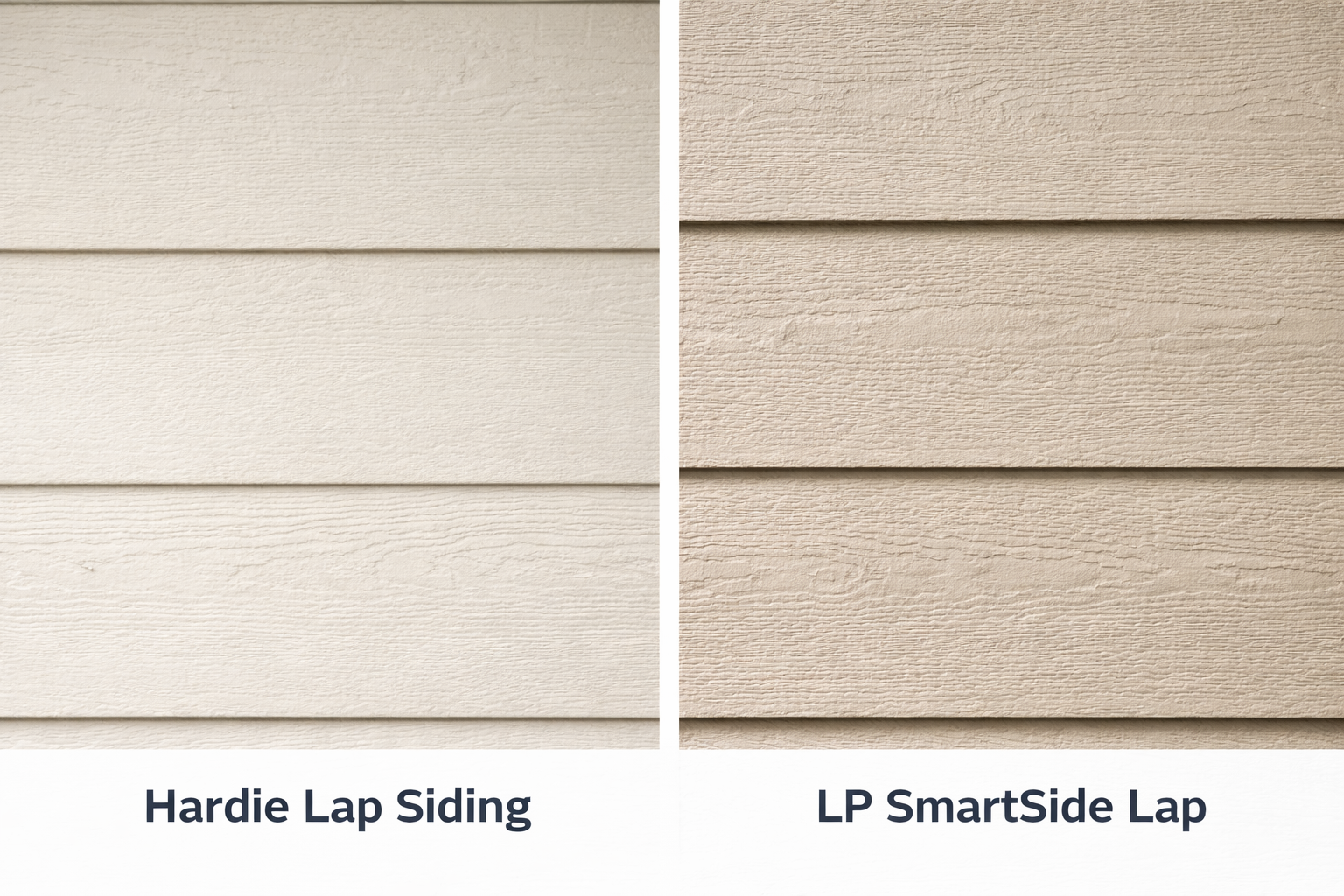
| Appearance | Premium wood grain or smooth | Good (improved over decades) | Deep, natural wood grain texture |
| Warranty | 30-year limited (ColorPlus) | Lifetime limited (varies) | 50-year substrate, 5-year finish |
| Resale Value Impact | High (premium perception) | Moderate (standard) | High (premium wood look) |
Need Help Choosing?
Talk to a licensed Tampa Bay contractor — no obligation, no pressure.
Moisture & Mold: Florida's #1 Siding Enemy
In Tampa Bay's subtropical climate, moisture management is the single most important factor in siding performance. Both materials handle moisture differently:
Hardie Board & Moisture
Fiber cement is inherently moisture-resistant — it won't rot, swell, or delaminate from water exposure. Its cement composition doesn't provide food for mold or mildew. However, it is a porous material that can absorb moisture at cut edges if not properly primed and sealed. Professional installation includes sealing all cuts and maintaining paint coatings.
Vinyl & Moisture
Vinyl is waterproof — moisture passes over it without absorption. However, vinyl siding systems are designed to allow water behind the panels (through weep holes and overlaps), relying on the house wrap beneath to shed water. If the house wrap or flashing is compromised, moisture trapped behind vinyl can cause hidden damage to sheathing and framing.
Bottom line: Both materials resist moisture well when properly installed. The critical difference is that Hardie board is more forgiving of less-than-perfect water management details, while vinyl depends heavily on the integrity of the weather barrier system beneath it.
Storm & Hurricane Durability
Tampa Bay homeowners don't have the luxury of ignoring hurricane performance when choosing building materials.
Wind Performance
Hardie board's density and rigid fastening make it exceptionally wind-resistant. Properly installed fiber cement can withstand 150+ mph winds. Vinyl siding uses an interlocking system that can resist 110–150 mph depending on the product, but panels can be pulled from the locking strips by strong winds — especially at corners and along eaves.
Debris Impact
This is where the materials diverge dramatically. Hardie board's density and rigidity allow it to absorb debris impacts that would puncture or shatter vinyl. Flying branches, patio furniture, and gravel that would penetrate vinyl siding may only dent or chip fiber cement. In a hurricane, this difference can mean the difference between cosmetic damage and a compromised building envelope.
Fire Resistance
Hardie board is classified as a non-combustible material (Class A fire rating). It will not ignite, support combustion, or release toxic fumes. In areas with wildfire risk or homes near wooded lots, this is a significant safety advantage.
Vinyl melts at approximately 300°F and can release hydrogen chloride gas when burning. While it's classified as a slow-burning material and meets building code fire requirements, it does not provide the fire separation that fiber cement does.
Long-Term Maintenance Comparison
| Maintenance Task | Hardie Board | Vinyl |
|---|---|---|
| Painting/refinishing | Every 10–15 years ($3,000–$6,000) | Never (color is integral) |
| Caulking/sealing | Inspect annually, reseal as needed | Minimal — check corners |
| Cleaning | Soft wash annually | Soft wash annually |
| Damage repair | Individual boards replaceable | Individual panels replaceable |
| 10-year maintenance cost | $500–$1,000 (between paint cycles) | $100–$300 |
| 20-year maintenance cost | $3,500–$7,000 (including one repaint) | $200–$600 |
The trade-off: Vinyl wins on maintenance convenience and cost. Hardie board wins on long-term durability and appearance quality — but requires periodic painting investment. Many homeowners choose Hardie specifically because they can change colors when repainting, keeping their home's look fresh.
Get Expert Advice for Your Home
Talk to a licensed Tampa Bay contractor — no obligation, no pressure.
Cost Comparison: Full Re-Side in Tampa Bay
Note: Costs include tear-off of existing siding, new house wrap, trim, and installation. Custom trim work, multi-story homes, and complex designs increase costs.
| Home Size | Vinyl (installed) | Hardie Board (installed) |
|---|---|---|
| 1,200 sq ft home | $6,000–$12,000 | $12,000–$20,000 |
| 1,800 sq ft home | $9,000–$16,000 | $18,000–$28,000 |
| 2,500 sq ft home | $12,000–$22,000 | $24,000–$38,000 |
| 3,500+ sq ft home | $18,000–$30,000 | $32,000–$50,000+ |
20-Year Total Cost of Ownership
When factoring in maintenance, repairs, and longevity, the cost gap narrows significantly. A vinyl installation at $12,000 with 20-year replacement at $14,000 totals $26,000+. A Hardie installation at $22,000 with one repaint at $4,000 and continued 30+ year life totals $26,000 — with a better product still on your home.
Curb Appeal & Home Value
Both materials offer dramatic curb appeal improvements over deteriorated existing siding. However, real estate professionals in Tampa Bay consistently rate fiber cement siding as a premium feature that increases perceived home value more than vinyl.
According to national remodeling cost vs. value data, fiber cement siding replacement recovers approximately 70–80% of project cost at resale, while vinyl siding recovers 65–75%. In Florida's market, where buyers increasingly prioritize storm durability, the premium for fiber cement can be even higher.
Which Is Better for Tampa Bay?
There is no universal answer. It depends on your priorities, budget, and how long you plan to own the home. Here is our recommendation framework:
Choose Hardie Board If:
- You plan to stay in the home long-term (10+ years)
- Maximum moisture resistance is your top priority
- You want the premium look of real wood without the maintenance
- Fire resistance matters (near wooded areas)
- You are investing in a comprehensive exterior upgrade (roof + siding + windows)
- Resale value maximization is important
Choose Vinyl If:
- Budget is the primary constraint
- Zero maintenance is a priority
- You are preparing the home for sale in the near future
- The home is a rental/investment property
- You want the project completed quickly
Choose LP SmartSide If:
- Impact resistance is your top concern (high debris risk areas)
- You want a deep, natural wood grain texture
- Faster installation matters (lighter weight, standard tools)
- Budget is between vinyl and Hardie
- You are comfortable with periodic maintenance and repainting every 8 to 12 years
The Siding Installation Process
- Inspection & measurement: We assess existing siding condition, sheathing integrity, and measure all surfaces. Free, no obligation.
- Material selection: Choose your material, profile style, and color. We bring samples to your home.
- Tear-off: Remove existing siding and inspect sheathing for damage. Repair any compromised areas.
- Weather barrier: Install new house wrap (Tyvek or equivalent) for moisture management.
- Trim installation: Install all corner boards, window and door trim, and architectural details.
- Siding installation: Install panels with proper spacing, fastening, and alignment per manufacturer specifications.
- Caulking & finishing: Seal all joints, penetrations, and transitions. Touch-up paint as needed for Hardie board.
- Final inspection & cleanup: Walkthrough, debris removal, and landscape restoration.
Transform Your Home's Exterior
Talk to a licensed Tampa Bay contractor — no obligation, no pressure.
LP SmartSide Engineered Wood Siding
LP SmartSide has become a legitimate third option for Florida homeowners who want a natural wood aesthetic with better durability than real wood. Understanding what it is and how it performs in our climate is important before making your decision.
What Is LP SmartSide?
LP SmartSide starts with oriented strand board (OSB), layers of wood strands bonded with resin. The entire product is treated with LP's proprietary SmartGuard process, which uses zinc borate to resist termites and fungal decay, plus a resin-saturated overlay for moisture protection. It is available in lap siding, panel, trim, and soffit profiles with a deep wood grain texture.
Pros for Florida Homes
- Impact resistance: The engineered wood substrate is flexible and absorbs debris impact rather than cracking. Outperforms fiber cement in impact testing.
- Natural wood appearance: Deep, authentic wood grain texture that many homeowners prefer over fiber cement or vinyl.
- Lighter weight: At approximately 1.5 lbs per square foot, it is significantly lighter than Hardie (2.5 lbs), making installation faster and easier.
- Standard tools: Cuts with standard carpentry tools without producing hazardous silica dust (unlike Hardie).
- Strong warranty: 50-year limited substrate warranty provides long-term confidence.
- Wind performance: Meets Florida Building Code wind requirements when properly fastened. Rated for 150+ mph with correct installation.
Cons for Florida Homes
- Organic substrate: Despite treatment, it is still wood at its core. In Florida's 75%+ average humidity, this requires more vigilance than inorganic materials.
- Shorter finish warranty: The 5-year factory finish warranty is significantly shorter than Hardie's 15-year ColorPlus finish warranty. Expect to repaint every 8 to 12 years.
- Termite protection is treatment-based: The SmartGuard zinc borate system provides strong protection, but it is not the same as fiber cement's total immunity (no organic material to eat).
- Shorter Florida track record: Hardie has decades of proven performance in Florida's climate. LP SmartSide is newer to the market and does not have the same long-term data in our specific conditions.
- Moisture at cut edges: Field cuts expose untreated wood that must be sealed immediately. Failure to prime all cuts can lead to moisture intrusion at those points.
Cost Comparison
LP SmartSide typically costs $8 to $13 per square foot installed in Tampa Bay, placing it close to Hardie board pricing. Labor costs may be slightly lower due to easier handling and faster installation. Material costs are comparable to Hardie's mid-range product lines.
Want a Siding Recommendation for Your Home?
Talk to a licensed Tampa Bay contractor — no obligation, no pressure.
What We Recommend for Homes in Tampa
After installing all three siding materials across Tampa Bay for years, here is our honest recommendation by situation:
- Best for most Tampa homes: James Hardie HardiePlank lap siding. It handles Tampa's humidity, heat, and storms better than any other material. The 30-year warranty and 15-year ColorPlus finish warranty provide long-term confidence, and it's the material most Tampa Bay contractors know and install correctly.
- Best for budget-conscious projects: Premium vinyl siding (insulated, .044"+ thickness). Lower upfront cost, zero maintenance, and adequate storm resistance for most Tampa neighborhoods. Best suited for interior communities away from direct coastal exposure.
- Best for natural wood aesthetics: LP SmartSide engineered wood. The deep wood grain texture is unmatched, and the 50-year substrate warranty is compelling. Just commit to timely repainting every 8 to 12 years, which matters more in Tampa's UV-intense climate.
- Best for coastal Tampa Bay: James Hardie. Its inorganic fiber cement composition is immune to salt air corrosion, which is a real concern for homes in Clearwater, Safety Harbor, and the beaches.
- Complete exterior upgrade: Pair siding with a Tampa roof replacement and impact windows for the full wind mitigation benefit and maximum insurance savings.
Once you have chosen a material, our Tampa siding contractor page covers installation, permitting, and what to expect on a local project.
Get Expert Help for Your Tampa Home
If you're unsure what option is right for your home, our team can help you evaluate your roof, windows, or siding. We provide honest assessments with no obligation and no pressure.
Your Home Deserves Better Than Deteriorating Siding
Whether you choose Hardie board, vinyl, or LP SmartSide, new siding transforms your home's appearance, improves energy efficiency, and provides critical storm protection. At Weathershield Construction, we install all three materials with equal craftsmanship and attention to detail.
Combine your siding upgrade with a new roof and impact windows for a complete exterior transformation that maximizes your wind mitigation insurance discount.
Serving Tampa, Carrollwood, Clearwater, and all of Tampa Bay.